Why You Understand English but Struggle to Speak It
You follow films, articles and meetings in English without effort — then freeze when it is your turn to talk. Here is what causes that gap and how to close it.
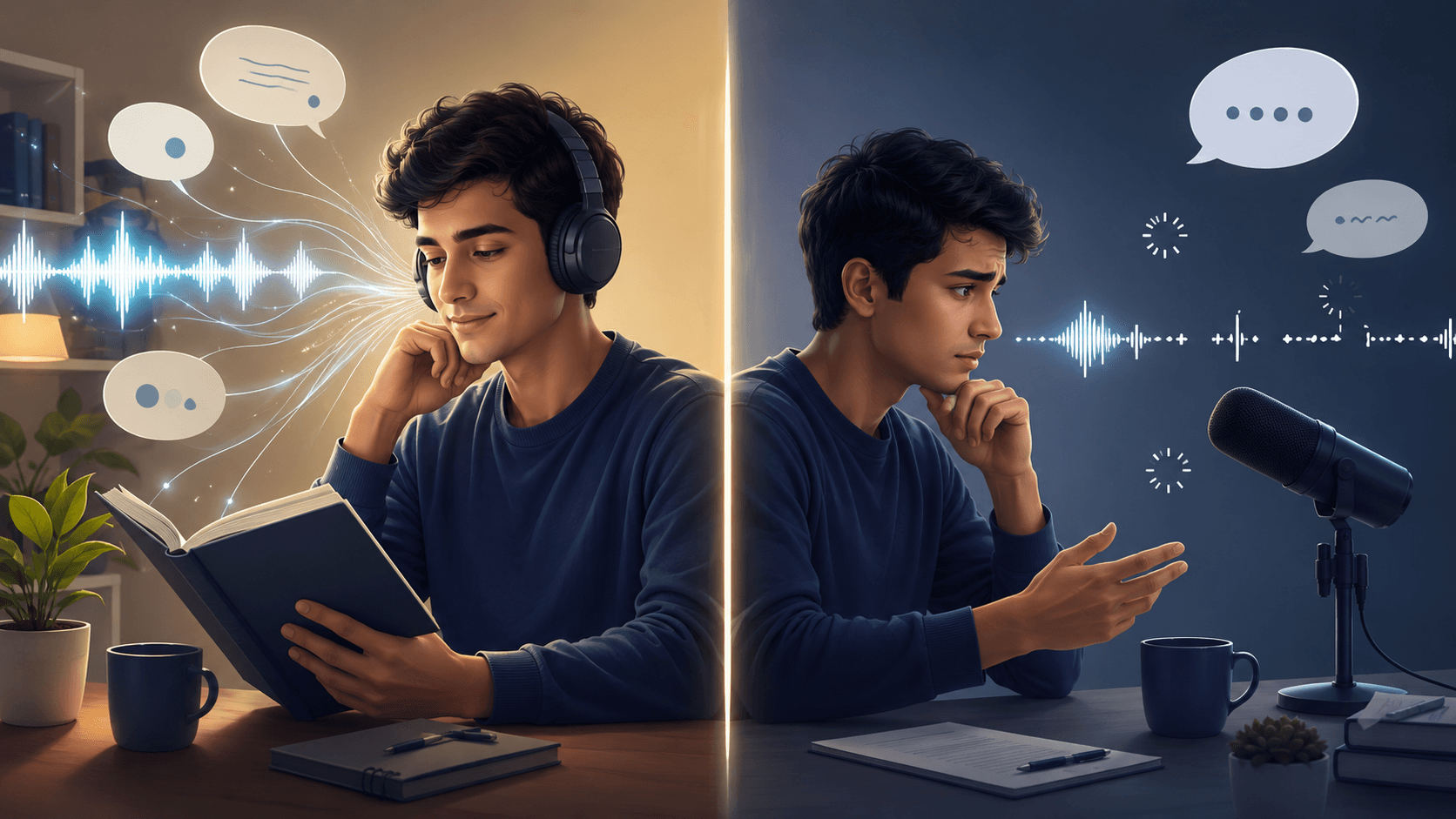
You can read an English news article without reaching for a dictionary. You watch series without subtitles. In meetings you follow every point being made. Then someone turns and asks what you think — and the sentence you had ready a second ago falls apart somewhere between your head and your mouth.
This is one of the most common experiences in language learning, and one of the most misread. Learners who hit it usually conclude their English is worse than they thought. It almost never is. What is actually happening is narrower and much more fixable.
The Problem
Understanding English and speaking English are not two levels of the same skill. They are two different skills that happen to share a vocabulary. One is recognition; the other is production. You can build a very large recognition ability while your production ability barely moves.
Recognition is generous. When you listen or read, the words arrive already chosen. Context fills gaps, tone carries meaning, and you can miss a third of a sentence and still follow it perfectly. There is no time pressure you control and no consequence for a small misunderstanding.
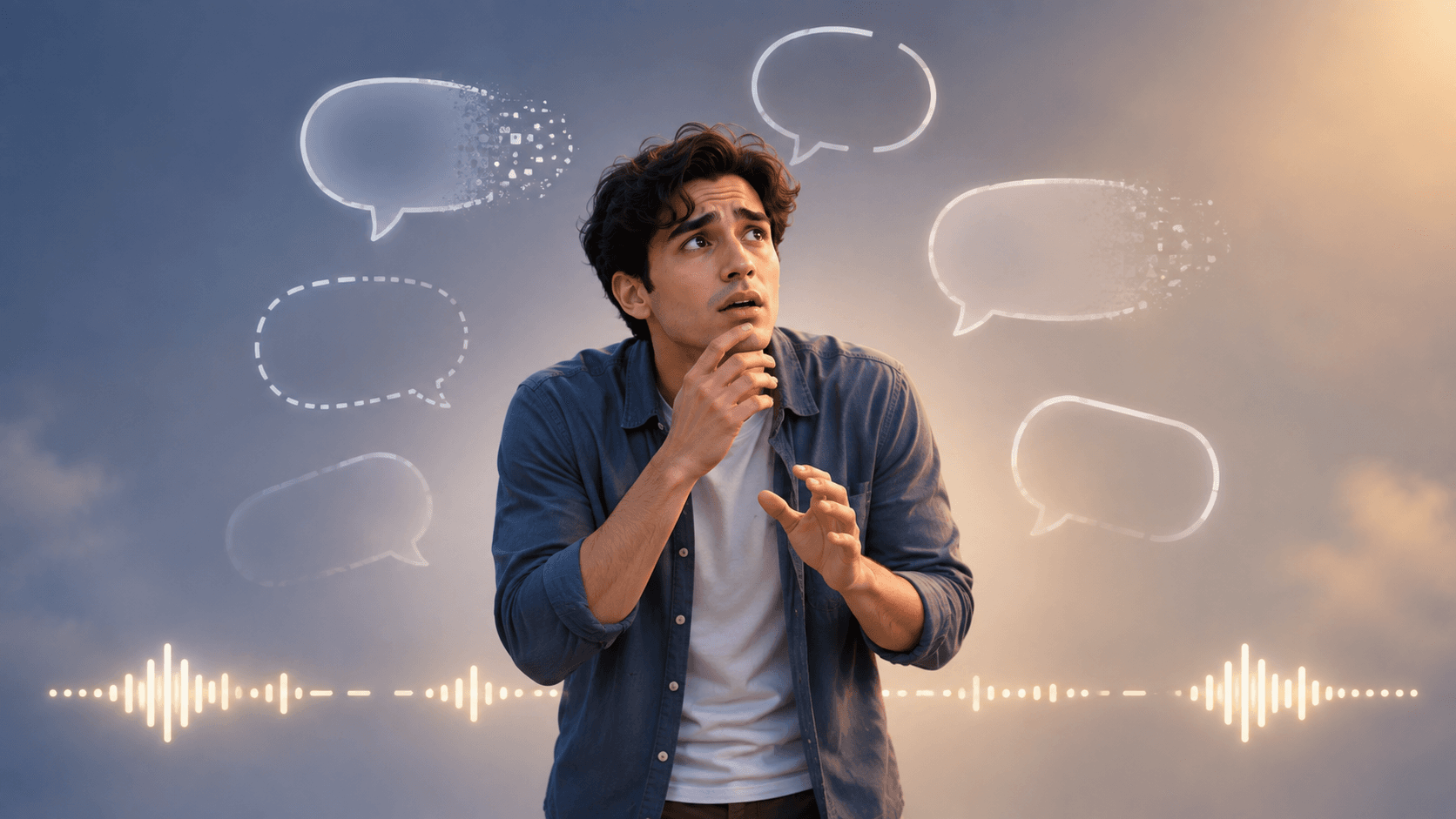
Production gives you none of that. You have to retrieve the word yourself, in the right form, in the right order, at conversational speed, while also listening to the other person and deciding what you think. The word you would recognise instantly on a page can be completely unavailable when you need to produce it out loud.
Why Does This Problem Happen?
Four things usually combine, and most learners are affected by all of them at once.
Your input hours vastly outnumber your output hours
Add up the English you consume in a week — video, music, articles, documentation, subtitles. Now add up the minutes you spend actually talking. For most learners the ratio is something like fifty to one. Comprehension is being trained constantly. Speech is barely being trained at all.
You are translating instead of composing
Early on, everyone builds sentences by forming the thought in their first language and converting it. It works on paper, where you have time. In conversation the conversion step is too slow, so you either pause in the middle or you produce a sentence that follows your first language's structure and sounds slightly off — which makes you hesitate more.
Mistakes feel expensive
If speaking mostly happens in situations that matter — a client call, a classroom, a colleague you want to impress — then every attempt carries a cost. So you say less, choose only the words you are certain of, and keep your sentences short. That is a sensible response to risk, and it also means you stop practising the harder half of your English.
There is nobody to practise with
This is the plainest reason and the one most often skipped over. Reading and listening need nothing but you and a screen. Speaking traditionally needs a second person who is available, patient, and willing to be a practice partner rather than just a conversation partner. Most learners simply do not have that on hand.
Notice that none of these are knowledge problems. Learning more vocabulary or another tense will not touch any of them, which is why the gap persists even as your English improves on paper.
The Solution
The fix is direct: you have to practise the thing you are bad at. Not more input. Not more grammar. Time spent forming your own sentences out loud, often enough that it stops being unusual.
What changes when you do this is worth being specific about, because it is not really about knowing more. It is about the words becoming reachable. A phrase you have said aloud twenty times arrives on its own. A sentence pattern you have used repeatedly stops needing to be assembled. Speech starts to come out in chunks rather than word by word, and the pause where you were translating quietly disappears.
This is also where the fear goes. Not because you get better at tolerating mistakes, but because after enough low-stakes repetitions, speaking English stops registering as an event.
How Does the Solution Work?
Compare the two loops. The one most learners are stuck in reinforces hesitation, because the pause is built into it:
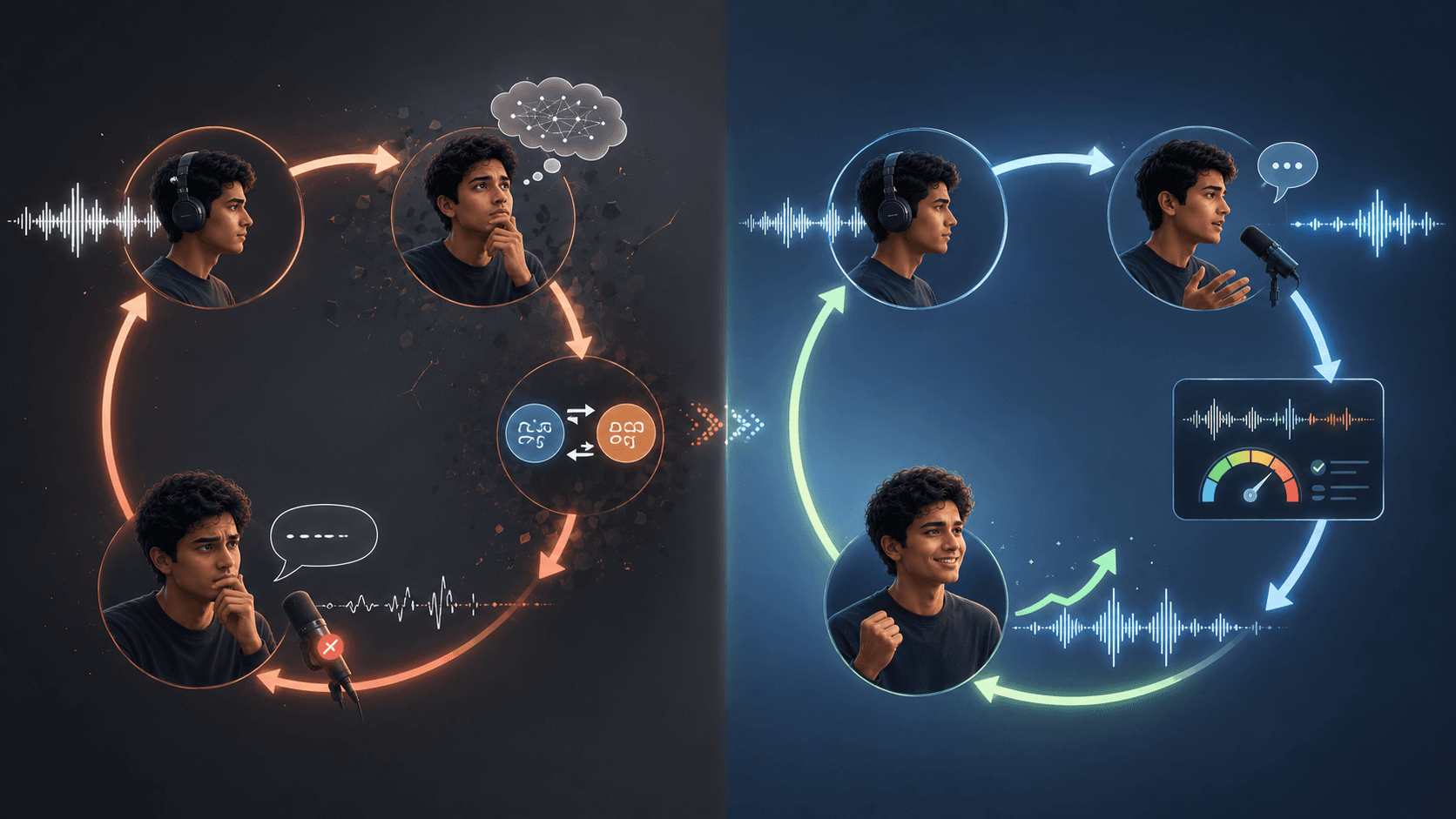
The second loop is short on purpose. You hear something, you answer it, you find out whether the answer worked, and you go again. Each cycle is small. The value is in the number of cycles, not the quality of any one of them.
Two details matter. The feedback has to be close to the attempt — a correction a week later is information, but a correction thirty seconds later actually changes what you say next. And the setting has to be low-stakes enough that you are willing to attempt the sentence you are unsure about, because those are the ones with something to learn in them.
How Gabfest Helps
Gabfest exists to make that second loop available whenever you have a few minutes. It is an AI speaking partner, which mainly means the practice does not depend on anyone else's schedule and does not cost you anything socially when a sentence comes out wrong.
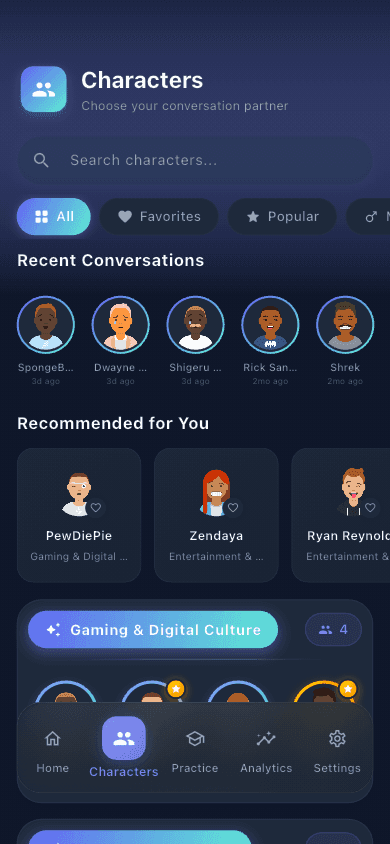
The parts most relevant to this particular gap:
- Voice calls with AI — real-time spoken conversation with audio streaming and pronunciation feedback. This is the core of it: you have to produce speech at conversational speed, which is exactly the skill that reading and listening never touch.
- Over 100 AI characters — different personalities and difficulty levels. Useful because adapting to an unfamiliar speaker is part of real conversation, and practising with only one voice teaches you to handle only that voice.
- Real-life scenarios — travel, shopping, meetings, social situations. Structured practice for the contexts you actually freeze in, rather than open-ended chat.
- Interview practice — mock sessions with follow-up questions and feedback on clarity, for when the stakes are real and you want the rehearsal done beforehand.
- Immediate corrections — grammar corrections as you type in text conversations, and pronunciation feedback during voice calls. Close enough to the attempt to affect the next sentence.
- Text conversations — a lower-pressure entry point on days when speaking out loud is not practical. Slower, but it still makes you produce the sentence yourself.
The full list is on the features page, though for this problem the voice calls are the part that matters. Everything else is support.
Key Benefits
What changes with regular speaking practice
- Words become retrievable, not just recognisable — you stop searching mid-sentence for vocabulary you already know.
- The mental translation step fades, because you have said the pattern often enough that it arrives whole.
- Speaking stops feeling like an event, which is what people usually mean by confidence.
- Your pronunciation gets corrected while the habit is still forming, rather than after years of repetition.
- You find out which sentences actually fail, instead of avoiding them and never learning.
How to Get Started
Keep the first week small enough that you will actually do it. Ten to fifteen minutes a day beats an hour on Sunday, because this is about accumulating repetitions.
- Pick one familiar topic — your work, your city, what you did yesterday. Familiar content lets you focus on producing speech rather than inventing ideas.
- Talk for ten minutes without stopping to correct yourself. Fluency first; accuracy is the next pass, not this one.
- Note the two or three moments where you stalled. That list is your actual syllabus, and it is far more useful than any generic vocabulary set.
- Repeat the same topic the next day. The second attempt is noticeably easier, and feeling that is what keeps people going.
- Add a new scenario once the old one feels routine.
Frequently Asked Questions
Does understanding English mean my English is already good?
It means your comprehension is good, which is genuinely valuable and harder to build than people credit. It does not tell you much about your speaking, because the two skills are trained separately. Most learners have a large gap between them, and that is normal rather than a sign something has gone wrong.
How long until I stop hesitating when I speak?
It depends on your starting point and how often you practise, so any specific number would be invented. What is predictable is the order: sessions get easier before your accuracy improves, and accuracy improves before speaking starts to feel automatic. Daily practice moves through those stages considerably faster than occasional practice.
Should I fix my grammar before I start speaking?
No — that ordering is what creates the gap in the first place. Grammar knowledge does not convert into speech on its own; it converts when you use it under time pressure. We looked at this more closely in Beyond Grammar: Why English Learners Need More Speaking Practice.
Is practising with an AI as good as practising with a person?
They are good at different things. A person gives you genuine unpredictability and real social stakes, which you eventually need. An AI gives you availability, patience, and a setting where a bad sentence costs nothing — which is what you need to build the volume of repetitions in the first place. Most learners benefit from starting with the second and moving toward the first.
Will my accent be a problem?
Being understood matters; sounding like a native speaker does not. Accents are normal and most of the world's English is spoken with one. It is worth working on specific sounds that actually cause confusion, and not worth trying to erase your accent generally.
Conclusion
The gap between understanding English and speaking it is not a sign that your English is weaker than you thought. It is the predictable result of practising one skill far more than the other, and it closes the same way it opened — through repetition, in the direction you have been neglecting.
You already have the vocabulary and the grammar. What you are missing is the mileage. If the reason you have not started is that there is nobody to practise with, that part has a solution now — and if what is really holding you back is nerves rather than opportunity, confidence comes from practice, not perfection is the more useful place to go next.
Start with one ten-minute conversation
Practise speaking English with an AI partner that is available whenever you are, and get feedback while it still matters.
Practise English with Gabfest